Approach
Our approach
A method that has been deliberately kept simple: short iterations, quick first versions, and long-term ownership.
Small team, direct communication, real software.
The way you work at Altena has been deliberately kept simple. No packs of paper, no long-term kick-off meetings with ten stakeholders, no Gantt-charts that are already obsolete on day one. Instead: direct communication, short iterations and as soon as possible something working to assess. That sounds simple, and it is. However, it requires discipline: no feature factory, no unnecessary technical complexity and the courage to leave things out. What follows is the standard working method for assignments and projects of any size.
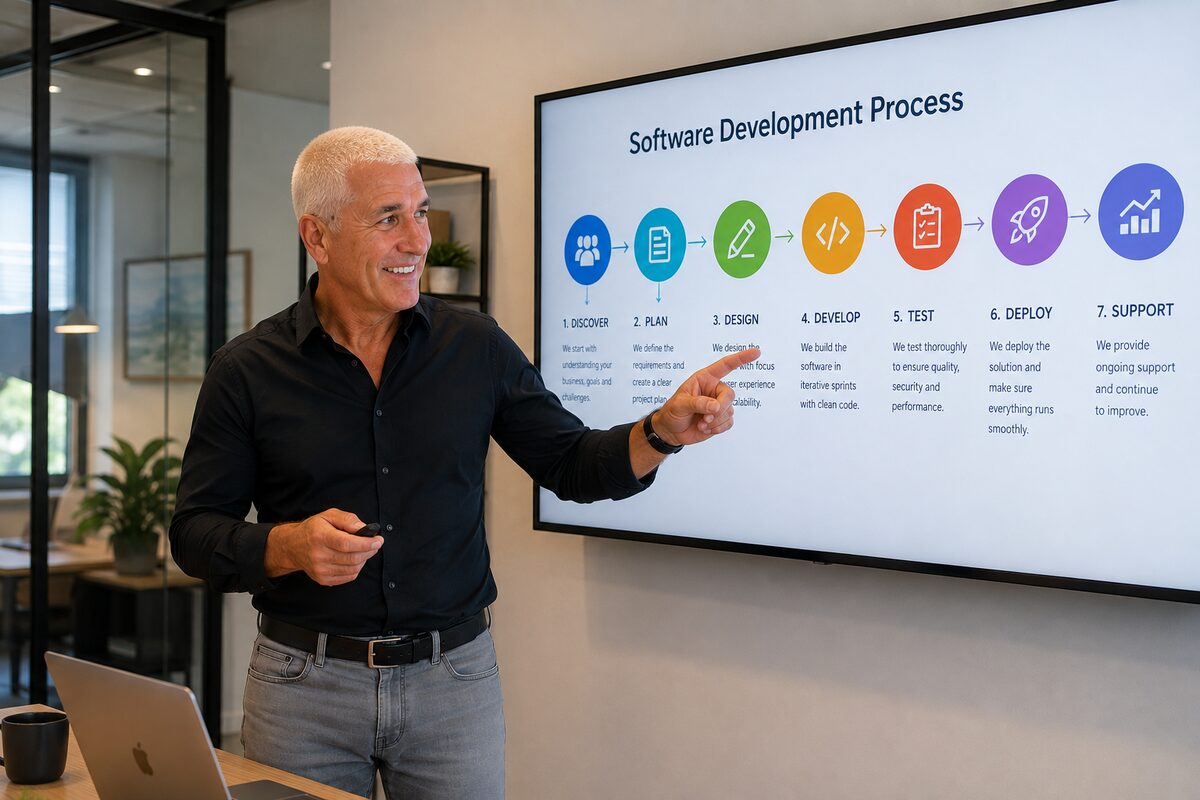
From your question to working software in predictable steps.
- 01
Understand before building
First the question is sharpened. What should it really solve, for whom, and why now? What assumptions are there under the question, and do they also knock? Only when that is clear, technology comes into the picture. Often this phase takes a few days to two weeks, and results in much more than it costs. - 02
A working version, quickly
Within a few weeks, not months, there is a first version. Something that can be opened, used and judged by real users. Not perfect, often bald, but really functional. From then on, every decision becomes more concrete because there is something to point to. - 03
Iterative development
Short cycles of building, measuring and reshaping, usually one to three weeks per iteration. What remains working, what does not work disappears. Decisions are supported by data and user feedback (according to the Agile manifesto), not with lower abdomen or HiPPO (highest paid person’s opinion). At the end of each cycle there is something more working than before. - 04
Long-term ownership
Software that lasts for years. Includes monitoring, updates and development. No surprise invoices, no vendor lock-in in weird places, and always clear what is maintained and what it costs. The relationship continues as long as the product runs.
Modern technology that grows with your needs.
The technology chosen is tailored to demand, but there is a solid basis of proven tools that quickly develop and enable good scaling.
The stack focuses on speed of development, low maintenance costs and good user experience. Open standards are preferred, and structural investments are made to test-coverage and monitoring so that further development can take place safely.
Frontend
- React
- Next.js
- TypeScript
- Tailwind CSS
- Vite
Backend
- Node.js
- PHP & Laravel
- PostgreSQL
- Redis
- REST & GraphQL
Infrastructure
- AWS
- Docker
- CI/CD pipelines
- Monitoring
- Automatic backups
What a typical project looks like.
Fixed contact point
One contact person for the entire journey, from design to live-gang and beyond. Your contact person is involved in design, development and management.Weekly progress
A short update per week with what has been done, what is planned this week, and what bottlenecks there are. No long status meetings if it also fits in an email.Transparent pricing
Fixed price per phase or capacity per month, depending on what suits best. No more work discussions afterwards and no surprises on the invoice.Custom code & data
For customization, the code and data is entirely with the client. Source code on its own Git server, infrastructure on its own accounts. No dependency that subsequently causes problems.Early and open communication
Troubles are reported before they grow up. Uncertainties are pronounced. Prefer to have early doubt rather than late regrets.Documentation as by-product
Decisions, architecture and company rules are laid down where they belong: in the code, in the README, in decision-making documents. Not as a loose activity afterwards, but during the work itself.
Ready to start?