
SaaS development
Turn a focused software idea into a first version for paying users. Own-product experience, a defined MVP and clear development costs.
Start with one problem worth solving
A SaaS product serves multiple customer organisations through online software. Alongside its core function, it needs account access, onboarding and a payment model. Each organisation must be able to work with its own data.
Altena Digital helps you choose the first audience and the task your product should help them complete. Our own products, AdComPro and CasaMio, provide concrete examples of connected workflows.
Our own product example: AdComPro
From project work to a reviewed invoice
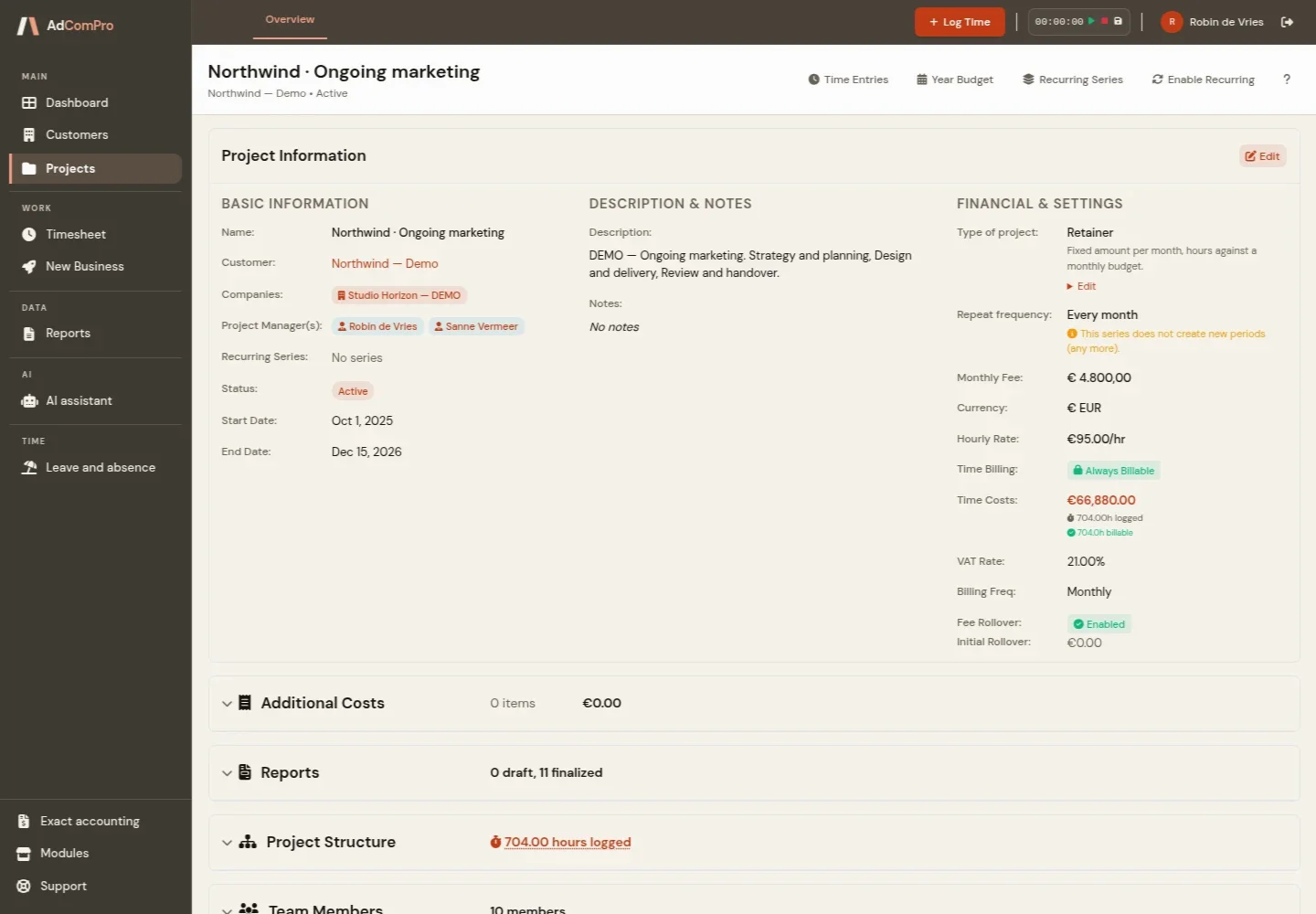
AdComPro connects projects, time tracking and invoicing. A team member records time against a project. Approved hours can become a draft invoice, which is reviewed before it is finalised. The workflow connects several features around one business task.
The public product screenshot shows project progress, budgets and team members using demo data.
A focused audience: CasaMio
CasaMio serves holiday rental businesses. Bookings, guest communication and cleaning tasks form part of the same daily operation. This is a useful starting point for an MVP: identify the tasks your audience actually needs to complete.
We define the problem, the buyer and the features that can wait. A focused first version gives you something to test with real users before expanding the product.
What goes into a first SaaS MVP?
- One audience and one defined core workflow, including its key exceptions.
- Organisation accounts, sign-up and a limited set of user roles.
- An onboarding route from registration to the first completed task.
- One subscription plan using an established payment provider and an agreed billing flow.
- A compact admin area and arrangements for feedback, error handling and maintenance.
Acceptance tests include attempts to access another organisation’s data through direct server requests and checks on revoked access. For payments, we define what should happen after failures, cancellations and repeated payment notifications.
SaaS development costs
Our indicative budget for a focused SaaS MVP is €15,000–€30,000 excluding VAT. This applies to the limited first version described above. It is a project estimate, not a fixed price for every software idea.
Native mobile apps, extensive AI features, multiple complex integrations, custom international tax handling and elaborate subscription structures are outside this indication. Hosting, maintenance, payment fees, third-party licences and data migration are budgeted separately.
After scoping, you receive a proposal covering features, acceptance criteria, schedule and price. We also document source-code ownership, access and handover arrangements. Further development follows actual use and feedback.
From idea to a tested product
- Define the audience, problem, business model and complete core workflow.
- Design the screens and discuss a clickable proposal with potential users.
- Build and test the core feature, permissions, organisation boundaries and payment behaviour.
- Launch with initial users and use their feedback to decide what comes next.
If you mainly need a private environment for existing customers, explore customer portal development. Its scope can differ from a standalone subscription product.
Frequently asked questions
How long does SaaS MVP development take?
The schedule depends on the core workflow, integrations and availability of feedback. We provide a timeline after defining the first version; a complete platform does not automatically fit a short MVP project.
Can you extend an existing SaaS product?
Yes. We first review its code, technology, data model and current user journeys, then determine how the requested changes fit the existing application.
Does this include an AdComPro subscription?
No. AdComPro is a separate product and an example of our work. The budget on this page covers developing your own software.
How do you keep organisations’ data separate?
We design organisation boundaries and enforce access on the server. Acceptance tests include direct requests for another organisation’s data and access after an account has been revoked.
Discuss your first version
Tell us who will use the software, which task it should support and which systems are involved. That gives us a useful starting point for a scoped proposal.